• 0 posts
  • 43 comments
Joined 2 years ago
Cake day: April 13th, 2024
  • How the hell did he arrive at the conclusion there was some sort of one-drop rule for non-protected works.

    Just because the registration is blocked if you don’t specify which part is the result of human creativity, doesn’t mean the copyright on the part that is the result of human creativity is forfeit.

    Copyright exists even before registration, registration just makes it easier to enforce. And nobody says you can’t just properly refile for registration of the part that is the result of human creativity.

  • But it does say right on that page:

    Take note that the network request logger in uBO is a forward-looking logger: this means only future requests can be logged.

    In the spirit of efficiency, uBO will log entries IF AND ONLY IF the logger is opened. Otherwise, if the logger is not opened, no CPU/memory resources are consumed by uBO for logging purpose.

  • With the short variable you probably also get shadowing. That’s super fun in a new code base.

    Or another favourite of mine: The first time I had to edit a perl script at work someone had used a scalar and a hash with the same name. Took me a while to realize that scalars, arrays, and hashes have separate namespaces, and the two things with seemingly the same name were unrelated.

  • Oh! Okay, that’s interesting to me! What was the input language? I imagine it might be a little more doable if it’s closer to hardware?

    I don’t remember that well, but I think the object oriented stuff with dynamic dispatch was hard to deal with.

  • that’s just how they are made.

    Can confirm, even the little training compiler we made at Uni for a subset of Java (Javali) had a backend and frontend.

    I can’t imagine trying to spit out machine code while parsing the input without an intermediary AST stage. It was complicated enough with the proper split.

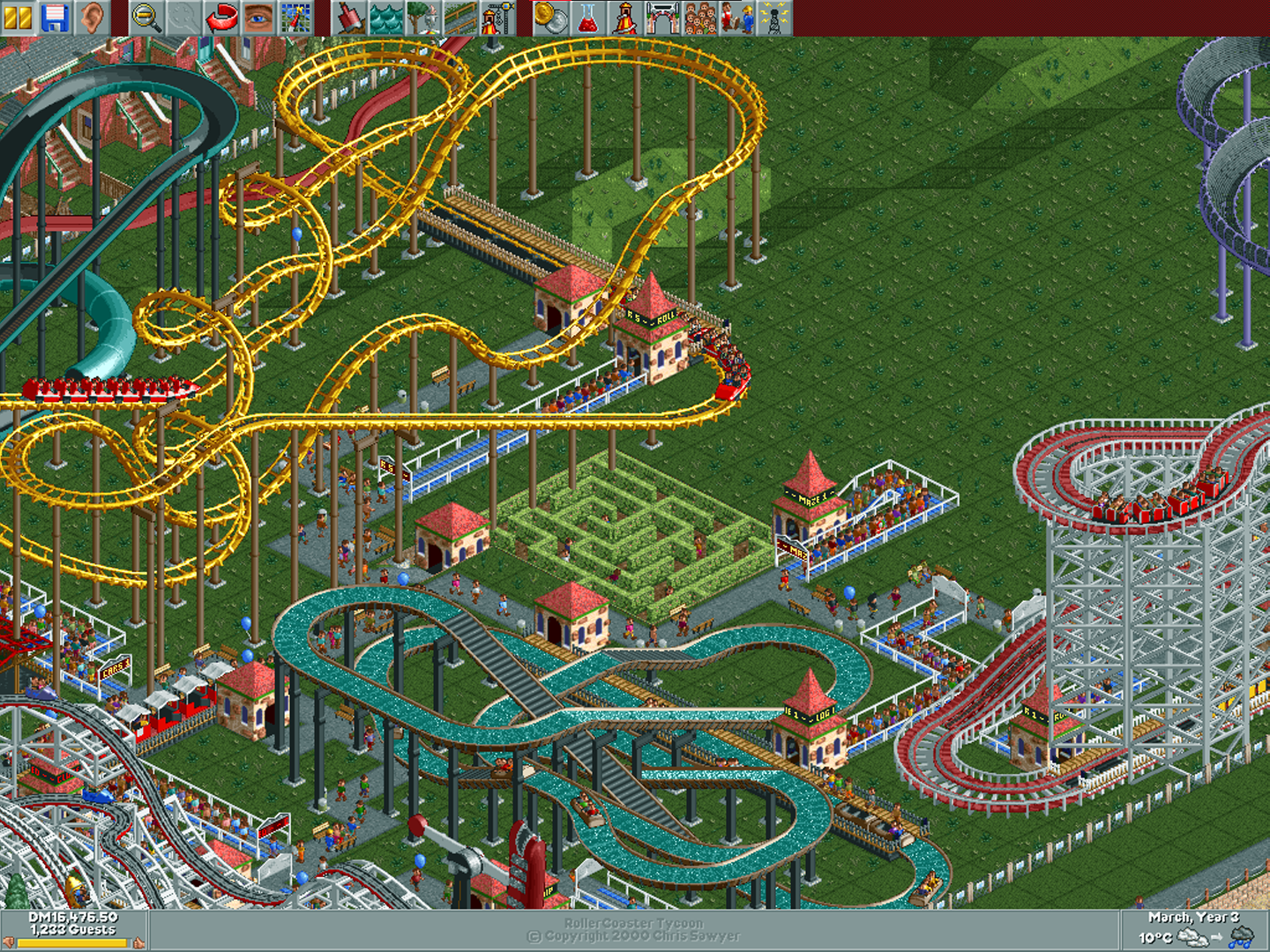
  • The original goes to 1024 x 786 and has different zoom levels. I’ve played most of the original parks this year and that does not see to be too high res to me. Give me a sec I’ll take a screenshot of mine in a minute.

    Edit here it is. It’s the GOG version, which launches fullscreen, so the 1024 x 768 are stretched onto the center of my 1920 x 1080 screen.

  • As @shane@feddit.nl says, you can use the same public port for many different destination address, vendors may call it something like “port overloading”.

    I just responded to him on that point, while you were typing to me. I didn’t know this existed, thanks for pointing it out!

    More importantly, you can install a large pool of public address on your CGNAT. For instance if you install a /20 pool, work with a 100 users / public address multiplexing, you can have 400,000 users on that CGNAT. 100 users / address is a comfortable ratio that will not affect most users. 1000 users / address would be pushing it, but I’m sure some ISP will try it.

    Sure, yeah, I have seen a few threads on NANOG about the NAT address ratios people are using. I also think I remember someone saying he was forced to use 1000 and it kind of worked as long as he pulled the heaviest users out of the pool. But if I recall correctly he was also saying he made IPv6 available in parallel to reduce the CGNAT load.

    But the point that made this post ridiculous and an obvious joke is that it said “one address” :-)

  • A TCP session is a unique combination of client IP, client port, server IP, and server port. So you can use the same IP and port as long as the destination is a different IP or port.

    Fair point! I wasn’t aware of any NAT working that way, but they could exist, I agree. It does blow up the session table a bit, but we are taking about a hell of a large theoretical system here anyway, so it’s not impossible.

    This wouldn’t help going to popular destinations, since they have a lot of people going to the same IP address and port, but for many (most?) of them you probably have some sort of CDN servers in your data centers anyway.

    Actually we have recently seen a few content providers not upgrading their cache servers and instead preferring to fall back to our PNIs (which to be fair are plenty fast and have good enough latencies). On the other hand others made new ones available recently. Seems there isn’t a universal best strategy the industry is converging on at the moment.