• 0 posts
  • 35 comments
Joined 3 years ago
Cake day: August 4th, 2023
  • Wow, hadn’t thought about that one in a long time. I thought it was an old Scott Hanselman blog and I was correct! I’ll have to reread it, been years now.

    I’m not sure there’s much why to it exactly. I feel like a small fraction of people I’ve met in life were truly passionate and excited about the work they did. Most had some passion for an art, or a hobby, or for their kids very commonly, but people who really want to grow and master their craft are somewhat rare generally. Most folks just want to do well enough to keep their jobs and then go home to whatever they actually care about.

  • It’s sad but i stopped writing answers or comments on SO years ago. I used to have all these optimistic ideas about people working together to collectively grow our shared knowledge. I guess Wikipedia and the Internet Archive keep barely hanging in there, but if anything those cases prove my point: without one extremely strong personality to hold the corruption in check, all these collaborative “digital commons” projects are a leadership change away from completely selling out all the work put into them. That can be feeding everything into AI but it’s also monetization schemes and EULA changes to claim ownership of user submitted content and locking the public out of your site without accounts and subscriptions.

    And usually the public’s only recourse is to tear it all down and start again, waiting for the next con artist to come along and steal the village’s prosperity.

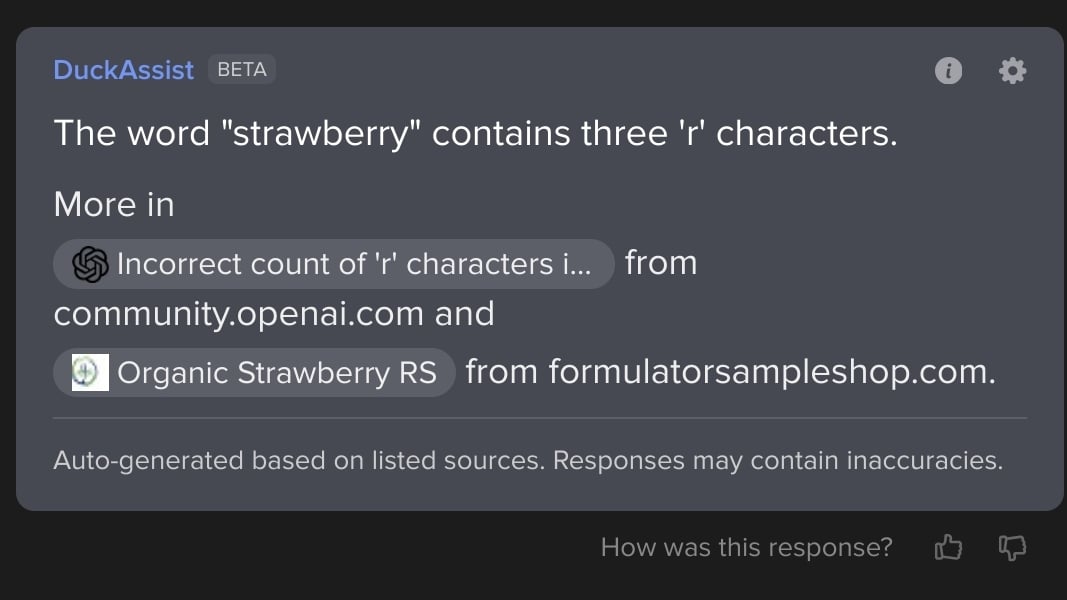
  • I was curious if (since these are statistical models and not actually counting letters) maybe this or something like it is a common “gotcha” question used as a meme on social media. So I did a search on DDG and it also has an AI now which turned up an interestingly more nuanced answer.

    It’s picked up on discussions specifically about this problem in chats about other AI! The ouroboros is feeding well! I figure this is also why they overcorrect to 4 if you ask them about “strawberries”, trying to anticipate a common gotcha answer to further riddling.

    DDG correctly handled “strawberries” interestingly, with the same linked sources. Perhaps their word-stemmer does a better job?

  • I think this probably applies…

    So Thief: The Dark Project (1999) and Thief 2: The Metal Age (2000), are a couple of classic stealth FPS games, proto-immersive-sims, and still some of my all time favorite games. They both use the Dark Engine, an in-house engine from the now defunt Looking Glass Studios, which also powered System Shock 2.

    In 2010, the source code to a System Shock 2 port (for the dreamcast or ps2 iirc…) leaked online, and on 2012 someone used that code to create NewDark and TFix, patches to make these old games work on modern computers (and some bugfixes, support for HD, etc).

    There are still updates regularly released for it too!

    I must emphasize that these games are still sold on Steam, GOG, etc and this patch is essentially required for them to work. And these are hardly the only games like this, just the ones most personal to me. Retrogaming is built on the backs of unsung individual heroes who backwards-engineer, hack, patch, and mod their favorite games to keep them running for everyone long after the publishers have died or abandoned their work.

  • This is still a business problem. The truth is, we solved basically all the technical problems that could be practically solved by the 2010s. We have all the technology, we know what people want and need. We could, and should, build a lifetime personal computer (phone form factor) for every person on Earth that provides for their communication needs, acts as a personal assistant and organizer, and more. And we’ve had those, dozens if times.

    But how do you keep selling people stuff once you’ve met all their needs? You tear it all down and keep rebuilding and reselling it. You enshittify to squeeze money out, customers flee, so you encircle them with another capitalist enclosure and rebuild the same shit again. Repeat.

    Software devs should basically all be making games and trying to teach AI to be smarter but instead we’re replacing internet search (a problem we solved in the 90s!) with LLM enabled advertising engines that literally can’t find info for you so they make it up. And we’re iterating on the 10 thousandth version of an e-commerce site because all internet shopping is part of a giant global MLM now. Seriously, “drop shipping” is the latest iteration of the same old scam they used to run on diet pills and knives and magazine subscriptions.

    But every college student with a fresh business degree can set up a Wix site to resell sunset lamps. It’s uber for scams. The reseller takes on all the risk, sets up the e-commerce site with a builder, firehoses ads all over their social media, and does all the work. There are multiple industries now entirely supported on conning desperate people into being your salesforce, workforce, advertisers, and customers all at the same time.

  • I’m just poking fun that the fundamental type in JS (Object) is an associative-array/hashmap. Technically it has some fancy under-the-hood handling for pure arrays and primitive types. This is also exactly true of Lua, and a little true of Ruby and Python.

    Really, most programmers would do great to start with a hash map or array list and only specialize out further when the problem calls for it.

  • Bro its so easy bro, just use flexboxgridcolumns its been a standard since 2010 just flex it bro you haven’t learned to flex yet just check w3c schools and add a flex you can polyfill it but don’t use that hacked one use the good flexpolyfill then { content-align-middle-child-elements: center-middle-true-neutral } so easy with flex bro

  • Someone shared this on Mastodon so I’ll just repost my thoughts from there. (Bonus for Lemmy, I was forced to squeeze all my thoughts into 500 characters, so this is the most succinct I’ve been on this site!)


    Pretty incredible how little people seem to understand these. For one thing, every method other than waterfall is a subtype of agile methodology. The major distinction is that waterfall has a series of phases from design through building, testing, and delivery that attempts to plan the whole project up front. Agile methods focus on smaller iteration cycles with frequent, partial deliverables.

    Something like kanban is designed for continuous delivery: we want to go to mars weekly.

    LEAN development is a scam though, that one is accurate.