You must log in or register to comment.
- 10 months
Needs to be a
sleep(3)andsleep(5)between the last ones just to add suspense- 10 months
Needs a 99% print too just before the 5 second sleep. Followed by a 99.9% and another 2 second sleep. Never print 100 and just run a traceroute in a loop.
Followed by a “we’re in” from the hacker as we’re made to believe he’s reading the console spam like he’s Neo from the matrix as he types faster and faster into an unresponsive terminal window.
- gigachad@piefed.socialEnglish10 months
It’s valid Python code though, the semicolons will run but are unnecessary
- 10 months
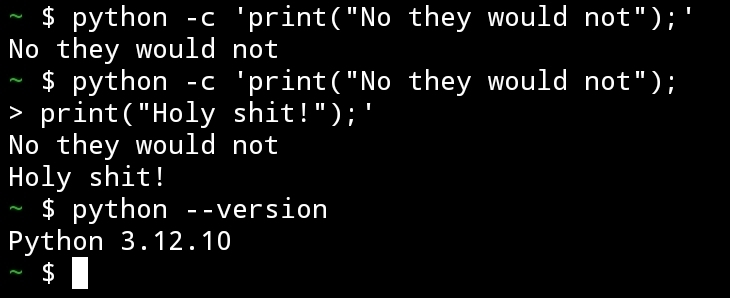
I am so perplexed and horrified. I’m going to need several weeks to get over this. What is this?!
- 10 months
It seems I had semicolons confused with braces:

if picture is broken, it’s this:
~ $ python -c "from __future__ import braces" File "<string>", line 1 SyntaxError: not a chance- 10 months
Guido undoubtedly had a strong, strong hatred of the number of ways braces are overloaded in Perl.
Do you really want an example?
sub doHref { { do { ${someglobal{Href}} = {} }; last }; }Every single pairing there serves a different syntactic purpose. Some are related purposes, and I’ve crowbarred a few in unnecessarily for the sake of an example, but different nonetheless.
The outer pair declares the
sub, and the next pair is a free block that works as a once-through unlabelled loop, which is exited with thelast. (Most other languages usebreakfor this purpose.)The next pair are for the
dowhich doesn’t act as a loop like the free block does. The next innermost pairing wrap a variable and the inner, innermost pairing indicate that the variable is a member of a hash (associative array) and we’re accessing the record namedHref.The lone
{}indicates a hash reference, so we’re assigning a reference to an empty, anonymous hash to that hash record.This example is ridiculous of course. There’s no need for most of those braces and syntax to do what it actually does. Also assigning to global variables is generally frowned upon.
sub doHref { $someglobal{Href} = {} }… is equivalent and cuts out most of the guff. Still three different uses though.
- 10 months
what about the sleeps between each print?
where’s the comments?
why isn’t it DRY?
3/10 code, PR rejected.
- 10 months
You know hackers in the movies are very polite and care for their user. When they are hacking or wiping the disk they show proper progress. That is much better user experience than many corporate products. Be like hackers in the movie.
- jaybone@lemmy.zipEnglish10 months
Ransomware has better tech support and customer service than your cell phone provider or ISP.
- 10 months
Their profits come from actual “customers”. They can’t just layoff half of their work force and use stock buybacks to make the line go up. Shit has to actually work.
- 10 months
For those who want a more convincing but still low-effort variant of this, use… https://hackertyper.net/
Press F11 in your browser to run it in fullscreen.
- 10 months
Did he type the furiously on to the keyboard? No? Then it’s not hacking.
- 10 months
I have seen like 2 movies where the hacker just ran a script and danced around the room until the progress bar got to the top, then he hit a couple inputs and ran another script and went back to dancing. It was so surreal to see something so much closer to real than the feverish hammering in a keyboard.
- 10 months
There’s also The Core where the hacker says “yea, I can do it”, demands unlimited hot pockets and all of Xena Warrior Princess on VHS, then locks himself up in his room.,
- 10 months
You’d be surprised how versatile that one thing is. Or, should I say, how much abuse it gets at ioccc…
- Evilschnuff@feddit.orgEnglish10 months
The hacking in Mr Robot looked more authentic, I really liked it. But they usually just executed some random scripts without printouts lol.
- 10 months
Yeah, few people know that the FBI tells you the progress when hacking them.
- 10 months
But look how much effort he put into ricing his terminal this guy’s good.
- PastafARRian@lemmy.dbzer0.comdeleted by creator10 months
“ChatGPT, write me a program to hack the FBI”
- 10 months
Guys, you can’t just come in here and post exactly how hackimg works.
That’s illegal!!1!