You must log in or register to comment.
- 3 years
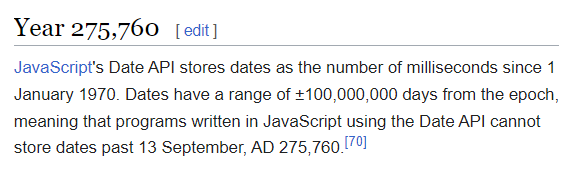
They’ll work on a solution in the year 275,759
…written in ES5, Python 2 and mostly Rust++
- 3 years
It’s fun how oddly close that year is with 0°C in Kelvin: 273.15. Seeing 275.8K just instantly brought me back to chemistry…
- 3 years
Bold of you to assume no one will come up with a replacement date library rather than just getting rid of JS.
- 3 years
It’s javascript. We’ll have gone through 275,760 new datetime libraries before then, it’ll be fine.
- 3 years
Of course! There’s already a proposal for a replacement Temporal object.
- 3 years
It’s not just a proposal, it’s already fully defined and almost completely implemented - I believe they’re just waiting on a standards update from ISO for time zone stuff.
- 3 years
Fun fact: infinities can be different sizes, such that one infinity can be larger than another.
They’re still infinities, with no end. Just of different absolute sizes. Fun stuff to rabbithole down into if you want to melt your brain on a lazy afternoon.
- 3 years
Even more fun: nobody can agree on how many there are (some people say none!), and mathematics is self-consistent regardless of if you assume certain ones definitely do or definitely don’t exist.
- 3 years
For all those who believe time is infinite please apply a logistic transformation to your dates.
In what unit? They’re not scale invariant.
Also in case you’re serious, I’m sure (by the pigeonhole principle) you’ll run out of exponents just about as fast as you would run out of integers.
- 3 years
boy do i have a bad news for you… https://en.wikipedia.org/wiki/Floating-point_arithmetic#Accuracy_problems
- 3 years
please apply a logistic transformation to your dates
Which is definitely a totally normal and everyday operation that normal people do with dates
- 3 years
for thousands of years dates counted upwards from a negative number
wat
- 3 years
Also means you can’t reference anything earlier than the late Pleistocene.
- 3 years
Sorry, that’s also wrong. The entire universe, in its current state, popped into existence last Tuesday. It’s been terribly inconvenient tho.
- 3 years
JavaScript shouldn’t have lasted as long as it has and it’s still used widely
- 3 years
What people fail to see is that this is the largest date the API can store, not a magical cutoff date in the distant future.
You could create a date today and send it to the API, and it could potentially crash it, or create a buffer overrun.
- 3 years
The definition of the Date object explicitly states that any attempt to set the internal timestamp to a value outside of the maximum range must result in it being set to “NaN”. If there’s an implementation out there that doesn’t do that, then the issue is with that implementation, not the standard.
- 3 years
That’s because this is the maximum integer that can be stored in a double precision floating point number without loss of precision, lol
- 3 years
That’s one thing that really bugs me about Javascript (weirdly enough I’m okay with eg prototypal inheritance and how
thisworks, or at least worked before the bolted on classes that were added because apparently I’m like one of the dozen or so people who had no problems with those concepts). The fact that all numbers are floats can lead to a lot of fun and exciting bugs that people might not even realize are there until they suddenly get a weird decimal where they expected an integer
- 3 years
I’ve got a bunch of freeze dried food from my backpacking days. Who wants to jump in on a business selling Y275.76K Survival Kits?
- 3 years
it may or may not be a monday - probably won’t. it will be monday based on the (4000 | year) => !(leap year) rule, but by the year 275000 the difference will be so big that i am pretty sure people will make more rules to solve that.
- 3 years
This will be a tough one to fix. There must be millions upon millions of embedded systems out there with 16-bit epoch burned in.
They’ll all be much tougher to find than “YEAR PIC(99)” in COBOL was.
Y2K wasn’t a problem because thousands upon thousands of programmers worked on it well in advance (including myself) we had source code and plenty of static analysis tools, often homegrown.
The 2038 bugs are already out there…in the wild…their source code nothing but a distant dream.