• 16 posts
  • 3 comments
Joined 1 year ago
Cake day: January 29th, 2025

cross-posted from: https://scribe.disroot.org/post/8843134

Op-ed by Kylie Moore-Gilbert, Research Fellow, Security Studies at Macquarie University.

Archived version

Once primarily the domain of non-state actors, including terror groups, drug cartels and armed gangs, hostage-taking has become a lucrative bargaining chip in the hands of countries like Iran, Russia, China, North Korea and Venezuela. (I was imprisoned by Iran for more than two years on false charges of espionage.)

It has become an unorthodox yet highly effective means of forcing concessions, including prisoner swaps, financial payments and the removal of sanctions.

However, very little scholarly research has examined the phenomenon. The data we do have on cases is patchy. This is in part because the governments whose citizens have been taken hostage usually prefer to negotiate in the shadows. We only tend to hear about select cases that attract media coverage.

Treating state hostage-taking as a consular issue to be solved via traditional diplomacy hasn’t worked. Bad actors haven’t been deterred; rather the opposite. An innovative new approach is long overdue.

Some of the ideas put forward in our research include:

1) Expanded international legal approaches

This includes reframing state hostage-taking as a form of torture and, under certain conditions, even a war crime or crime against humanity.

UN torture rapporteur Alice Edwards argues this would help open avenues for victims seeking justice … Legal academic Carla Ferstman governments should look to existing models in the US and Canada and consider passing legislation to allow victims of state-sponsored terrorism to sue hostage-taking states in their domestic courts.

2) Stronger government-led responses to hostage-taking

Many countries don’t have a designated office or role within government to coordinate domestic and multilateral responses to hostage-taking.

These positions exist now in the US and Canada. This step was also proposed in a 2024 Australian Senate inquiry into the wrongful detention of Australian citizens overseas. The government has yet to respond to the inquiry.

3) Innovative models for multilateral rapid responses to hostage crises

Several contributors to the journal have proposed new ideas for how states can do this, including former Canadian Justice Minister and Attorney General Irwin Cotler (with international human rights lawyer Brandon Silver) and former hostage Michael Kovrig (with international security and diplomacy expert Vina Nadjibulla).

Their recommendations include:

  • developing rapid-response mechanisms to hostage-taking in pre-existing multilateral groupings, such as the G7 or NATO

  • strengthening the Declaration on Arbitrary Detention in State-to-State Relations (launched by Canada and now supported by more than 80 nations)

  • imposing multilateral sanctions and other tools of economic leverage against states that engage in hostage-taking.

4) Greater investment in post-detention recovery care for both victims and families

Proposals for taking better care of former detainees came from the NGO Hostage International, human rights lawyer Sarah Teich and an Israeli team involved in designing reintegration programs for Gaza hostages.

These proposals include:

  • passing legislation to mandate a “duty of care” by governments to former hostages

  • developing new strategies for helping former hostages overcome their psychological challenges, based on emerging research in the field.

Archived version

In almost four years of Russia’s invasion of Ukraine, it has become evident that Moscow’s technological alliances have reshaped not only the future of the battlefield but also the foundations of international security. The threats no longer lie in the number of tanks or missiles that a given army has. As the war in Ukraine has shown, technological advances in unmanned aerial vehicles (UAVs) and advanced radar jamming technologies have allowed for asymmetric application of such technologies, often rendering classical concepts of deterrence, defense, and security architecture obsolete.

At the center of this shift stands a China-enabled drone supply network that is rapidly transforming Russia’s capacity for sustained, cost-effective, and scalable warfare.

Chinese-supplied components in Shahed-type and now Geran drones enable longer-range, more cost-effective, and precise strikes. The result is an increasing asymmetric threat to the European continent and beyond. Even more alarming are reverse technological transfers to Moscow’s other Asian allies, such as North Korea, which has been rumored to receive both technology and manufacturing training for the Shahed/Geran drones.

If left unaddressed, this China-enabled supply chain risks becoming the backbone of a new model of warfare that exploits cost asymmetries, sanctions loopholes, and alliance-based technology transfers across multiple domains simultaneously.

Chinese-made components is much more substantial [according to] Ukrainian drone specialists [who] indicate that Russia has made significant upgrades to three dimensions of Shahed/Geran drones: maneuverability and controllability, jamming resistance, and tactical versatility. Combined, these upgrades allow Russia to test new asymmetrical tactics that are becoming an increasingly challenging issue for air defenses in Ukraine and could be utilized beyond Ukraine in the future. Russia’s UAV barrages continue playing a successful role in strikes on Ukraine’s energy infrastructure as part of Russia’s cognitive warfare as well.

Chinese-supplied components that enable Geran’s maneuverability and controllability also allow for other tactical and asymmetric applications. As an example, Ukrainian Air Forces and Army Aviation Forces have been seen utilizing helicopters and Yak-52 trainer aircraft as airborne anti-Geran defenses. To counter this threat, a Geran-2 drone has been fitted with an R-60 air-to-air missile. While currently rumored to be a one-off occurrence, the integration of heat-seeking missiles into the drone makes Geran a fully fledged air-to-air weapons-systems platform.

In 2025, Moscow also conducted drone incursions over NATO airspace. Reports from the incident in Poland indicate that the Gerbera decoy drones were used in these provocations. While most of the drones were successfully neutralized, the equipment used to shoot down the drones shows both the asymmetric threat of such barrages and the unprecedented levels of cost-effectiveness that Moscow was able to reach.

Russia is also rumored to be supplying North Korea with the technology for Shahed/Geran drones and even employing and training up to 12,000 North Korean workers in its Geran drone production lines. Combined with the effectiveness of constant drone innovation and technological transfers within Moscow’s close-knit circle of allies, it is only a matter of time until the spillover effect of the Geran drones reaches the Asia-Pacific and alters the strategic balance in the region.

Ukrainian defense specialists emphasize that Russia’s military-industrial sector continues to acquire drone technologies … often via third countries that re-label and repackage components, making traceability nearly impossible under current sanction frameworks. Recent reports of drones produced entirely from Chinese parts further underscore the selectivity of Beijing’s export restrictions and the vulnerability of current EU and U.S. controls.

Targeting these networks demands coordinated monitoring of Russia’s parallel import hubs in Hong Kong, the United Arab Emirates (UAE), India, Kazakhstan, Kyrgyzstan, Turkiye, Vietnam, and the Balkan states, alongside penalties for intermediaries and financial institutions supporting these schemes.

Equally important is addressing the role of e-commerce platforms, where dual-use components can be purchased in small but continuous volumes and aggregated into a significant industrial supply source for Russia’s drone assembly lines. Restricting these procurement routes is essential for limiting Russia’s ability to sustain its cost-effective asymmetric warfare capabilities and the broader China-enabled military-industrial complex. Sanctions must not only focus on intermediaries directly supplying Russia but also on financial institutions enabling monetary transfers, such as Russian burner banks.

Stickers with the slogan ““Russia is not my enemy” have appeared in Romania, France, and Italy.

[…]

“Russia has launched the propaganda campaign ‘Russia is not my enemy,’ which has reached Romania. Stickers with this message are appearing in cities as part of the Kremlin’s hybrid campaign aimed at creating the illusion of a ‘peaceful partnership.’ Through such tools of influence, Russia seeks to portray itself as a peacemaker, downplay its own crimes, and sow discord within European societies,” the statement by the Center for Countering Disinformation under Ukraine’s National Security and Defense Council said.

[…]

The Center added that the purpose of the campaign is to undermine citizens’ trust in the rule of law and democratic institutions in their countries, cast doubt on the Euro-Atlantic course, and discredit support for Ukraine.

[…]

Russia has significantly intensified hybrid attacks on the EU’s critical infrastructure since the start of its full-scale invasion of Ukraine.

As Donald Trump’s executive order in March led to the shuttering of Voice of America (VOA) – the global broadcaster whose roots date back to the fight against Nazi propaganda – he quickly attracted support from figures not used to aligning themselves with any US administration.

In Moscow, Margarita Simonyan, the hardline editor-in-chief of the state broadcaster RT described it as an “awesome decision”. The Global Times, an English-language Chinese state media publication, crowed that the broadcasters had been discarded by the White House “like a dirty rag”, ending their “propaganda poison”. Azerbaijan’s president, Ilham Aliyev, whose regime has been accused of repressing political opposition, described Trump’s move as “very promising”.

Domestically, Trump has continued to target the media, whether by taking outlets including CBS News and ABC to court, attempting to block political access to the White House by the Associated Press, or defund National Public Radio and the Public Broadcasting Service – institutions he has described as “radical left monsters”.

For many senior media figures around the world, there has been a tipping of the scales as authoritarian regimes are emboldened by a US administration not only attacking the media at home, but also withdrawing from the fight for free information overseas.

Jonathan Munro, global director of BBC News , says: “Three-quarters of countries around the world don’t have free media, and that figure is getting worse, not better.

“It’s not just the lack of free media. It’s the proactive and aggressive march of disinformation and misinformation, which arrives on people’s phones 24 hours a day. That’s a cocktail for a very badly informed, or misinformed, global population.”

Munro says authoritarian regimes were already reacting to the withdrawal of the west and growing their own presence.

cross-posted from: https://scribe.disroot.org/post/2631767

Archived version

The European Union has not signaled any reciprocation as China announces lifting of sanction from several members of the EU Parliament, imposed in 2021 as a response to EU’s sanctions on some Chinese officials, citing human rights violations in Xinjiang.

The lifting of sanctions means that the MEPs will now be able to travel to China. The move is being perceived as a potential kick starter for better relations between China and the European countries.

[…]

The diplomatic battle between China and the European Union peaked in 2021 when EU took the first step, sanctioning Chinese officials. China responded in kind and sanctioned some MEPs. This rift dimmed the chances of signing of a trade and investment deal between China and EU which was finalized at the end of 2020.

[…]

Over the years, China and the EU have maintained difficult ties, in which the EU has consistently criticized China for not fulfilling human rights obligations.

[…]

While Beijing is courting Europe portraying itself as a friend as Trump’s tariffs policy threatens its economy, the Chinese propaganda at home shows Chinese troops rehearsing in Moscow for the parade with Russia that invaded Ukraine.

Here is an Invidious link of a footage reportedly captured a Chinese student in Russia (original YT link is here).

cross-posted from: https://scribe.disroot.org/post/2600244

Archived

Poland’s foreign minister … used an annual address to parliament to send a sharp message to Russian leaders as war continues in neighboring Ukraine, asking: “Don’t you have enough land?”

Foreign Minster Radek Sikorski described the difficult situation Poland faces with the war across the border and the threat of its expansion, and voiced concerns about the “disintegration” of Western unity.

Poland, on NATO’s eastern flank, is one of Kyiv’s strongest supporters, and Sikorski used his speech to strongly criticize Russia.

He said, addressing Russian leaders: “Don’t you have enough land? Eleven time zones and still not enough? Take care of better governing what is within your borders according to international law.”

“For Poland, the greatest threat would be the disintegration of the Western community. That is why we cannot afford illusions or inaction. We cannot afford to be alone,” Sikorski said.

He had a warning for Russia. “You will never rule here again, neither in Kyiv, nor in Vilnius, nor in Riga, nor in Tallinn, nor in Chisinau,” he said, listing the capitals of Ukraine, Lithuania, Latvia, Estonia and Moldova.

He also noted that the situation on the front lines in eastern and southern Ukraine is “ambiguous,” and that Russian forces’ slow progress is paid for “with huge losses.”

“After three years of this stage of the war, which Putin planned for three days, Russian troops control only about 20% of Ukrainian territory and are still stuck in eastern Ukraine,” Sikorski said.

“It is estimated that the war has already cost Russia at least $200 billion, and almost a million Russian soldiers have been eliminated from the battlefield. Ukrainian losses are smaller, and they have not allowed either the capture of their capital or the installation of a puppet government.”

cross-posted from: https://scribe.disroot.org/post/2600126

Archived

In a remarkable example of how times have changed, Japan is expanding its military with NATO.

There was a time when the notion of a militarily assertive Japan would’ve sent shivers through the spines of world leaders. Indeed, the Japanese themselves, mindful of both the suffering that their nation inflicted and then suffered in return during World War II, pursued a pacifistic foreign policy throughout the Cold War and for even much of the post-Cold War era.

What a difference eight decades, and the looming threat of Chinese aggression, make. Nations that once shuddered at the thought of a stronger Japan now welcome it. This can be seen in Japan’s newly bolstered ties with the Philippines as well as multinational partnerships such as “The Quad” (among India, Australia, Japan, and the United States). And now, in a perhaps even more remarkable example of how times have changed, Japan is expanding those military ties beyond the Indo-Pacific over to NATO.

“China, North Korea, and Russia are stepping up their military exercises and their cooperation, undermining global stability, and that means what happens in the Euro-Atlantic matters for the Indo-Pacific and vice versa. So our security, I believe, is inseparable,” [NATO Secretary General Mark Rutte said].

“China is supporting Russia’s efforts. China is building up its armed forces, including its navy, at a rapid pace. We cannot be naïve, and we really have to work together, assess what is happening,” [Rutte said].

  • Tihis is somehow related regarding ‘sanitising:’

    Uyghur Genocide: Activists slam Disney for filming Mulan in Xinjiang

    Activists and netizens have been outraged after Disney shot several portions of the action movie Mulan in parts of China where it is believed that authorities have placed countless people, mostly Uyghur Muslims, in concentration camps, subjecting them to human rights abuses. Campaign for Uyghurs Executive Director Rushan Abbas in a video message said she was horrified by the choice of Disney to shoot there ignoring the genocide of people by communist China.

    “Triggering more controversies and objections from the netizens, the final credits of the movie thanked a government security agency in Xinjiang province.”

    Social media users noticed that in the credits Disney thanked a number of government entities in Xinjiang, including the public security bureau in the city of Turpan and the “publicity department of CPC Xinjiang Uyghur Autonomy Region Committee”, reports BBC.

    The public security bureau in Turpan is tasked with running China’s “re-education” camps where Uighurs are held in detention.

    Walt Disney Co. Chief Financial Officer Christine McCarthy said the company’s decision to shoot some scenes of ‘Mulan’ in a controversial region of China has ‘generated a lot of issues for us’, reports Bloomberg.

    Campaign for Uyghurs Executive Director Rushan Abbas said the issues raised by Disney’s choice to film in a land stained by China’s genocide has serious implications for the entire global community, and especially for the Muslim ummah worldwide …

cross-posted from: https://scribe.disroot.org/post/2560198

Archived version

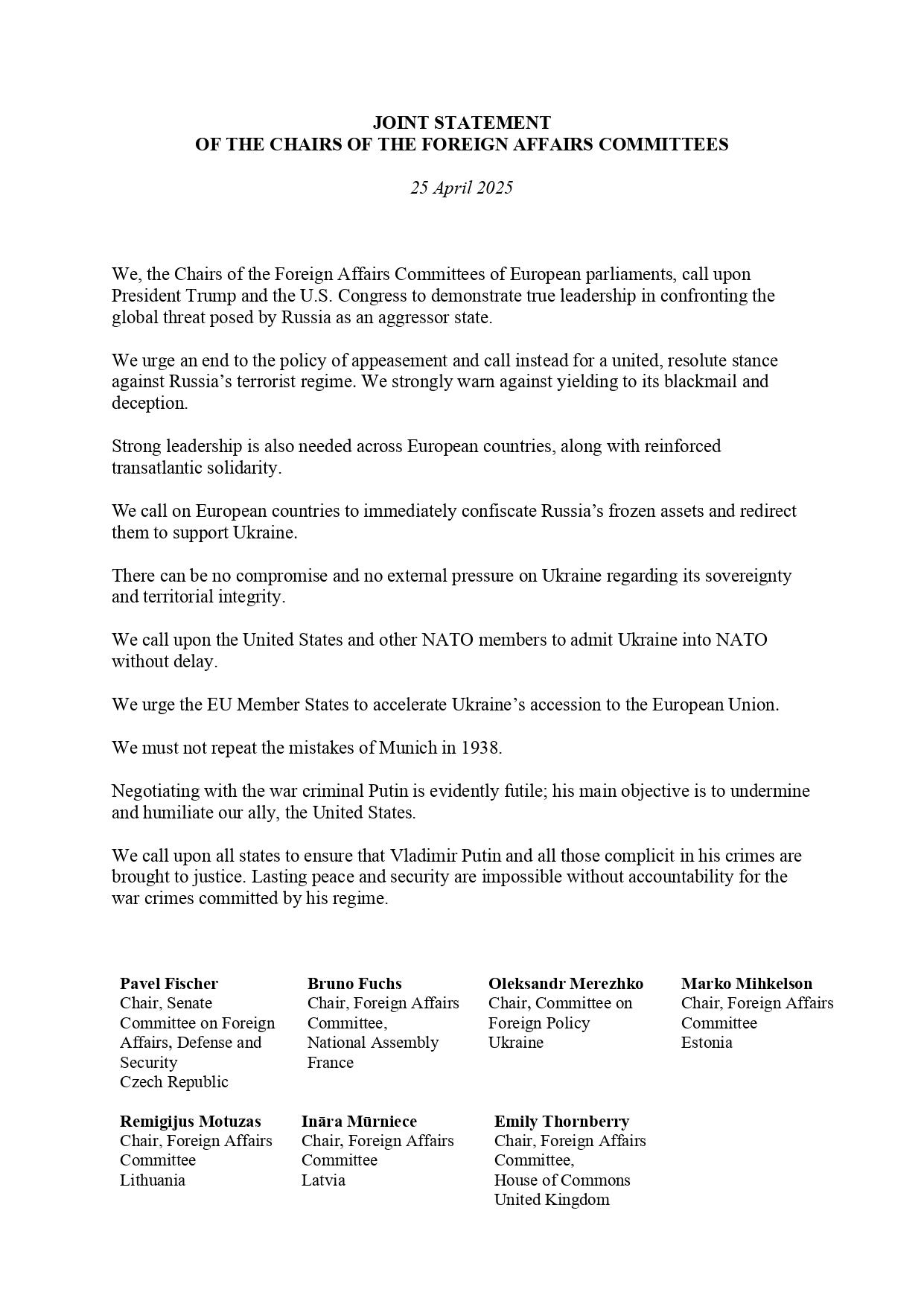
Chairs of the foreign affairs committees of eight European parliaments on April 25 urged U.S. President Donald Trump to end “the policy of appeasement” towards Russia, and called for a “resolute stance” against Moscow, according to a document seen by the Kyiv Independent.

“We strongly warn against yielding to its blackmail and deception,” the statement reads.

The statement is signed by chairs of the foreign affairs committees of the U.K., France, the Czech Republic, Lithuania, Latvia, Estonia, and Ukraine.

“We urge an end to the policy of appeasement and call instead for a united, resolute stance against Russia’s terrorist regime.”

“Negotiating with the war criminal Putin is evidently futile; his main objective is to undermine and humiliate our ally, the United States. We call upon all states to ensure that Vladimir Putin and all those complicit in his crimes are brought to justice.”

“We must not repeat the mistakes of Munich in 1938.”

“There can be no compromise and no external pressure on Ukraine regarding its sovereignty and territorial integrity.”

[The latter point is noteworthy as the U.S. is reportedly proposing its de jure recognition of Russian control over Crimea, which Russia has occupied since 2014, as part of a potential peace deal.]

The signatories also urged Europe to confiscate Russia’s frozen assets and redirect them to support Ukraine.

[Edit typo.]

cross-posted from: https://scribe.disroot.org/post/2559835

Russia became increasingly aggressive and provocative toward European countries in 2024, employing espionage, cyberattacks, and covert disinformation campaigns to influence public debate, according to the annual report released by the General Intelligence and Security Service (AIVD). The agency described Russia’s actions as approaching the level of state terrorism aimed at spreading fear across Europe. The report also highlighted a rise in extremist threats within the Netherlands.

“The regime uses sabotage that borders on state terrorism to sow fear in Europe,” the AIVD stated in its report.

[…]

On Tuesday [April 22], the Military Intelligence and Security Service (MIVD) disclosed that Russian hackers attacked a Dutch public facility in 2024. The specific facility was not identified. The incident was part of the agency’s annual report and signals a significant shift in how national security is viewed, with threats now considered the norm rather than the exception. “From uncertainty as the exception to uncertainty as the rule,” AIVD Director-General Erik Akerboom said in the report.

According to the AIVD, the Netherlands faced a “multitude of threats” in 2024. The agency issued 73 official intelligence reports to the Public Prosecution Service—17 more than in 2023. These classified communications typically alert authorities about individuals who may be involved in criminal activity and allow prosecutors to initiate investigations.

Many of the AIVD’s investigations were linked to shifting global power dynamics and ongoing international conflicts. “The balance of power is changing, and the question is what the future world order will look like,” the report noted. “Anyone who assesses the threats to the Netherlands in 2024 will not only wonder what kind of world we live in, but also what we must do in response to this threat landscape.”

Alongside Russian threats, China also posed significant dangers. The Chinese government targeted a Dutch military research network with malicious software in a bid to spy on Dutch governmental and political targets. The AIVD report stated that China aimed to reduce Western influence worldwide through collaboration with Russia.

In addition to joint geopolitical efforts, China supplied military goods to Russia, including attack drones. These drones are frequently deployed in Russia’s ongoing war against Ukraine.

cross-posted from: https://lemmy.sdf.org/post/33177843

  • Major Russian banks set up netting system for China trade
  • Aim is to cut risk of secondary sanctions
  • System has lower commissions, is set to expand
  • Xi due to visit Russia in May, meet Putin

Major Russian banks have set up a netting payments system dubbed “The China Track” for transactions with China, aiming to reduce their visibility to Western regulators and mitigate the risk of secondary sanctions.

[…]

Russia’s trade with China hit a record $245 billion last year despite payment problems and commissions running as high as 12%, as Chinese banks had grown too cautious to do business with Russia and jeopardise their ties with the United States.

[…]

The issue had become so important that Russian President Vladimir Putin and China’s President Xi Jinping discussed it during Putin’s visit to China in May 2024, which was aimed at cementing the two countries’ ‘no limits’ partnership.

Xi is set to take part in Russia’s Victory Day parade on May 9, but his visit is now taking place amid China’s trade war with the United States, making the booming trade with Russia and other non-Western nations more important.

[…]

The new system has been set up by major sanctioned banks and involves a web of intermediaries registered in countries that Russia considers friendly. The system has been in place for some time and has not yet suffered any major setbacks.

Each bank runs several verified payments agents, some of whom handle payments for exports, and some for imports. All payments are then netted centrally at the bank with all the counterparties involved receiving their money.

The banks settle trade in both directions, said market sources, who spoke on condition of anonymity due to the sensitivity of the issue.

[…]

cross-posted from: https://scribe.disroot.org/post/2468670

Archived link

The Serbian government wanted to launch golden passport programs in 2022 and then significantly simplify the issuance of citizenship to Russians working in the country, reducing the residency period before applying for citizenship to one year. But, as the Financial Times reported, the European Commission put pressure on Belgrade. They threatened to suspend the Serbia-EU visa-free regime, if the granting of citizenship through investor schemes is deemed to pose an increased risk to the internal security and public policy of the Member States of the European Union.

As IStories discovered, European countries still have something to fear. In hundreds of decisions on granting Serbian citizenship for services rendered from 2022 to April 2025, the names of dozens of Russians closely connected to the military-industrial complex, the Kremlin, oligarchs, state corporations, and even special services are listed. None of them appear on sanctions lists and, therefore, can travel freely with a Serbian passport.

Several Russian billionaires from the Forbes list and people formerly associated with managing the assets of oligarchs Alisher Usmanov and Alexei Mordashov also became citizens [of Serbia], however, there is no information about their current relationship with the Russian government.

cross-posted from: https://scribe.disroot.org/post/2458687

Archived link

On the morning of April 15, Russian state-run news agency RIA Novosti published — and later deleted — two Telegram posts that appeared to show military drone operators directing strikes against Ukrainian territory from a makeshift control center located inside a residential high-rise in Moscow City, the Russian capital’s business district.

The first post claimed that a “combat FPV drone, controlled from Moscow, struck an Armed Forces of Ukraine target in Chasiv Yar at an ultra-long distance for the first time.” The second post said the UAV, piloted remotely from Moscow, had been launched by the drone unit of the Espanola brigade, which was operating near Chasiv Yar — a city in the Bakhmut District of Ukraine’s Donetsk Region, most of which is under Russian control.

A six-minute video accompanied the posts, showing the coordination of the drone strike in detail. Both posts, along with the video, were removed within 90 minutes of publication. The Telegram channel CHTD first noticed that the posts had been taken down.

cross-posted from: https://scribe.disroot.org/post/2447669

Archived version

Three years into the full-scale war in Ukraine, the Kremlin’s propaganda machine is still hard at work telling Russians that the invasion is justified, Ukraine and the West are to blame, and Vladimir Putin is acting in their best interests. But U.S. President Donald Trump’s first two months back in office have complicated this narrative. His efforts to rebuild ties with Moscow have led Russian state media and officials to swing from cursing the U.S. over the war to praising its president for his kind words about Putin and his dismantling of institutions like USAID. To unpack how Russian propagandists have handled this about-face,

[In an Q&A session, the independent journalist] Ilya Shepelin, who tracks pro-Kremlin media and formerly hosted the show “Fake News” on TV Rain, unpacks how Russian propagandists have handled this about-face.

[…]

Question: For more than a decade now, Russian propaganda has pushed the idea that America is Russia’s eternal enemy, and that U.S. policy is rooted in hatred and fear of our country. But the moment Trump said a few kind words about Putin, Russian TV suddenly forgot all about this existential standoff and started gushing over this “wonderful man” and the America that’s supposedly about to become great again. Were you surprised by this sudden shift?

Ilya Shepelin: I’m not sure there’s anything left that can still surprise me — and that’s a serious professional problem […] So no, I’m not surprised that Russian propaganda suddenly started singing America’s praises. Especially since Trump’s own style of politics fits perfectly with how Russian propaganda operates. He’s not bothered by obvious contradictions. One day he’ll post that Zelensky is a dictator with a four percent approval rating, and a week later he’ll tell a reporter he never said or thought any such thing.

[…]

It’s all about raw, exaggerated emotion — pure and simple. The same kind you see with soccer fans. If something good happens — say, Trump says Putin’s a great guy and one of the greatest leaders ever — we celebrate and gush over the U.S. president. But the moment Trump decides to extend sanctions put in place by the previous administration, we’re suddenly tearing our hair out and ripping down the posters of him we just hung over our beds.

[…]

it’s not about full-scale mobilization [of Russian people] — it’s about offering narratives that help people make peace with what’s going on [the war]. Something like, “Look, politicians around the world are hypocrites — that’s even worse than what Putin’s doing. At least he’s doing it for Russia. The others are just scheming against us.”

[…]

“Scaling” is a key idea here [as the actual fighting in Ukraine is over small villages that few people have ever heard of]. How does Russian TV portray battle maps of some village in a random district of Donetsk? They act like like they’ve stretched a map of Europe across the screen. Just zoom in close enough, and it starts to feel like we’re not talking about a few square kilometers, but hundreds or thousands. Like it’s a world-shaping event. A massive conquest.

And really, the actual territory doesn’t matter much to the propaganda. What matters is the image of the army steadily advancing, day by day, while the enemy retreats in shame, losing one village after another. And to keep it from feeling like a toy war bought off AliExpress, they constantly show our soldiers fighting and dying heroically on the front lines.

[…]

They never talk about the number of casualties on [Russian state-controlled] TV [as Russia’s casualty numbers are massive]. The last official figure the [Russian] Defense Ministry mentioned was, I think, five thousand. On TV, they’re always talking about the hundreds or thousands of enemy soldiers killed, constantly showing videos of them dying. And when they talk about fallen heroes, it’s always just a few, and they’ve either saved 20 people or killed 140 enemies before they died.

[…]

Russian society is highly atomized. The people who are fighting and dying went there voluntarily, for money that’s unimaginable to most of the country. And that helps remove the sense of personal connection to the tragedies of those who’ve died. It’s seen as the price for taking the risk.

[…]

[Russian general Andrey] Gurulyov is constantly saying insane things, like that we should drop a nuclear bomb on Britain or wipe out a quarter of Russia’s population because they’re all Western agents. But suddenly [when peace negotiation started with the US], this guy ended up on the blacklist of federal channels. He disappeared from the airwaves after he called Trump a “bandit” who shouldn’t be sitting at the same table [with Putin].

[…]

Now he’s having to appear on regional channels, popping up on [far-right Russian Orthodox news network] Tsargrad TV. And you can really see how his rhetoric has changed. Now he says, “Well, of course, we all want victory, but right now the U.S. is calling for a settlement, and when the U.S. accepts our terms, that’ll be the victory.

So, just by cutting someone off from federal airwaves, you can instantly change their [the people’s] view of victory. Not long ago, he was demanding Odesa and Kyiv, and now he’s happy with recognition from the U.S. There’s no real issue with victory at all. Whatever they achieve in negotiations, that’s what they’ll portray as a victory.

cross-posted from: https://scribe.disroot.org/post/2411873

Archived version

China and the European Union are unlikely to become close allies quickly, analysts say, even as U.S. President Donald Trump’s tariffs sour relations between the world’s largest economy and both its transatlantic allies and Beijing.

“I don’t see the EU and China uniting against the US,” Max Bergmann, director of the Europe, Russia, and Eurasia Program at the Center for Strategic and International Studies (CSIS) said.

“I think there will be interest on both sides but deep practical constraints for both. Unless China is willing to make some big concessions, I struggle to see the EU uniting behind a strategy of deeper engagement.”

The EU and China have a fractious relationship. While China is one of the EU’s biggest trading partners besides the U.S., economic relations between the two have also historically been characterized by investigations and tit-for-tat measures linked to trade.

The EU has long alleged that Beijing subsidizes key sectors such as electric vehicles, batteries and steel and aluminum in a way that is harmful to global markets and competitiveness. Last year, the EU hit China with tariffs on electric vehicles, as a result.

… And it is not only trade that is causing tensions in the EU-China relationship, Carsten Nickel, managing director at Teneo, [said].

He added that there are “fundamental differences” between the two “regardless of what is going on with the U.S.”

“That has to do with unresolved questions around overcapacity in China. It has to do with ongoing misgivings in the European Parliament, especially regarding the human rights situation, and it has to do with concerns over China’s support for for Russia and Ukraine,” he explained.

Ian Bremmer, founder and president of the Eurasia group, also pointed out that there is a “deep” European mistrust toward China in areas like intellectual property and technological surveillance, as well as industrial policy.

This “doesn’t go away with the United States becoming an adversary.”

“I think it’s pretty clear that that that doesn’t that that doesn’t mean that the the the underlying challenges in the European relationship with China are gone overnight,” he added.

Eurasia Group’s Emre Peker and Mujtaba Rahman echoed this idea in a Thursday note.

“Trade diversions as the US-China tariff fight escalates will prompt the European Commission to swiftly deploy safeguard measures to prevent China—and other countries—from dumping their goods on the EU market,” they said.

European policymakers will use “softer rhetoric” towards China to avoid triggering a trade war on two fronts. “But this is highly unlikely to translate into Brussels-Beijing cooperation against Washington,” they concluded.