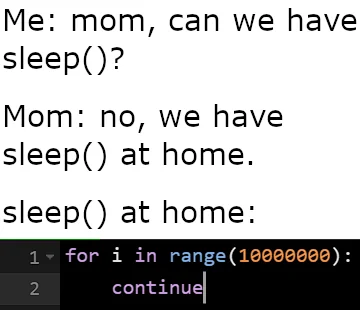
I think some compilers will just drop that in the optimization step.
- 3 years
Real pain in the ass when you’re in embedded and your carefully placed NOPs get stripped
 3 years
Tell the CPU to wait for you?
Na, keep the CPU busy with useless crap till you need it.
- 3 years
I’ve written these cycle-perfect sleep loops before.
It gets really complicated if you want to account for time spent in interrupt handlers.
- 3 years
Thankfully I didn’t need high precision realtime. I just needed to wait a few seconds for serial comm.
- 3 years
Nah, some MCUs have low power modes.
ESP32 has 5 of them, from disabling fancy features, throttling the clock, even delegating to an ultra low power coprocessor, or just going to sleep until a pin wakes it up again. It can go from 240mA to 150uA and still process things, or sleep for only 5uA.
- 3 years
This should be the new isEven()/isOdd(). Calculate the speed of the CPU and use that to determine how long it might take to achieve a ‘sleep’ of a required time.
I took an embedded hardware class where specifically we were required to manually calculate our sleeps or use interrupts and timers rather than using a library function to do it for us.
- Dr. Moose@lemmy.worldEnglish3 years
Javascript enters chat:
await new Promise(r => setTimeout(r, 2000));Which is somehow even worse.
- ExtraMedicated@lemmy.worldEnglish3 years
I actually remember the teacher having us do this in high school. I tried it again a few years later and it didn’t really work anymore.
- 3 years
On my first programming lesson, we were taught that 1 second sleep was
for i = 1 to 1000😀, computers was not that fast back then…- ferret@sh.itjust.worksEnglish3 years
I mean maybe in an early interpreted language like BASIC… even the Intel 8086 could count to 1000 in a fraction of a second
- 3 years
This was in 1985, on a ABC80, a Swedish computer with a 3 MHz CPU. So, in theory it would be much faster, but I assume there were many performance losses (slow basic interpretor and thing like that) so that for loop got close enough to a second for us to use.
- 3 years
I just measured it, and this takes 0.17 seconds. And it’s really reliable, I added another zero to that number and it was 1.7 seconds