
- 3 years
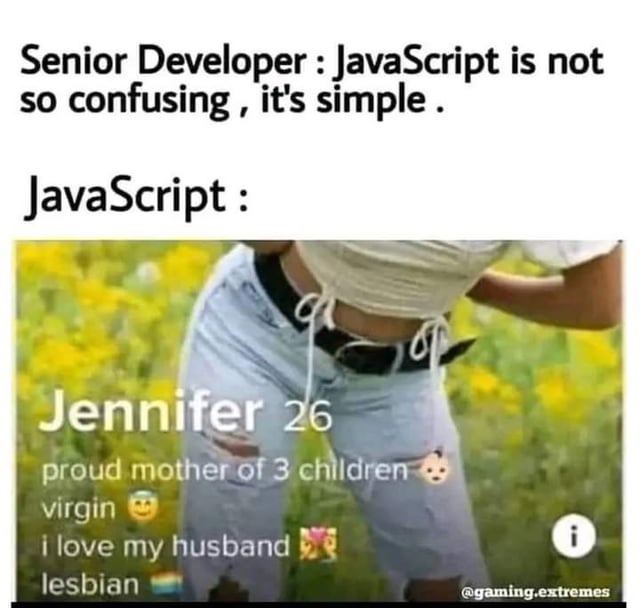
Jennifer is a lesbian. Her wife, now husband, who she’s proudly supportive of, is FtM, with 3 previous children that Jennifer adopted. Jennifer has never had penetrative sex with a man.
- SpicyKetchup@lemmy.worldEnglish3 years
This would make her not a lesbian after her husband transitioned.
- morphballganon@lemmynsfw.comEnglish3 years
Depends. Could be. A person transitioning doesn’t necessitate their partner finding their new body attractive.
artificial insemination; beard marriage, loves her husband platonically. I am a JS dev.
- 3 years
Lesbian, in marriage with another lesbian and adopted 3 kids. Still virgin.
- 3 years
Her partner is actually a woman, but dynamic type casts made her write “husband”.
I was thinking they were his kids from the previous marriage, though artificial insemination works just as well!
- 3 years
I’ve had a JavaScript certification for over a decade now and I think I hate you.
- 3 years
Java devs are prima mental gymnasticists, always able to make anything make sense.
- 3 years
JS !== Java
Try Javascript some day!
- We have truthy and falsy! Empty string or null? Yeah, that’s false!
- Of course we can parse a string to number, but if it’s not a number it’s NaN!
- null >= 0 is true!
- Assign a variable with =, test type equality with == and test actual equality with ===. You will NEVER use the wrong amount of = anywhere, trust me!
- Our default sort converts everything to string, then sorts by UTF-16 code. So yes, [1, 10, 3] is sorted and you are going to live with it.
- True + true = 2. You know I’m right.
Try Javascript today!
- Durotar@lemmy.mldeleted by creator3 years
Our default sort converts everything to string, then sorts by UTF-16 code. So yes, [1, 10, 3] is sorted and you are going to live with it.
I’m not sure whether this is satire or not.
- 3 years
It’s not. The default sorter does that, because that way it can sort pretty much anything without breaking at runtime. You can overwrite it easily, though. For the example above you could simply do it like this:
[3, 1, 10].sort((a, b) => a - b)Returns:
[]- 3 years
The default sorter does that, because that way it can sort pretty much anything without breaking at runtime.
who the fuck decided that not breaking at runtime was more important than making sense?
this js example of
[1, 3, 10].sort()vs[1, 3, 10].sort((a, b) => a - b)will be my go to example of why good defaults are important
- 3 years
who uses utf 16? people either use utf 8 (for files) or utf 32 (for string class O(1) random access)
- 3 years
I made the thing in the thing print “hello world” with C# once, is Javascript for me?
- 3 years
True + true = 2. I’ve heard memes about Javascript, but jeez. It’s really that bad?
- Coreidan@lemmy.worldEnglish3 years
If you have that much difficulty with JavaScript then it’s likely you’ll suffer with any language.
- 3 years
Except strict equality, that’s a JavaScript only problem. Imagine thinking
"0"should be falsy in comparison due to string literal evaluation, but truthy with logical not applied based on non-empty string. Thus!"0"=="0"is true. They couldn’t just throw away==and start over nooooo let’s add===. Utter madness- 3 years
Browser compatibility. Design flaws can’t easily be fixed like how other languages can just switch to a new major version and introduce breaking changes. ES must keep backwards compatibility so has had to do more additive changes than replacing behavior altogether so that older web pages pages don’t break.
Meanwhile google is about to break the internet with html drm
- 3 years
Strict vs loose equality has gotten me so many times, but I can sort of see why they did it. The problem you mention with integers 0 & 1 is a major annoyance though. Like it is fairly common to check whether a variable is populated by using if (variable) {} - if the variable happens to be an integer, and that integer happens to be 0, loose quality will reflect that as false.
But on the other side, there have been plenty of occasions where I’m expecting a boolean to come from somewhere and instead the data is passed as a text string. “true” == true but “true” !== true
- 3 years
Lua does intrinsic evaluation of strings that i’d argue is not nearly as crazy. I get the value of it since half of interpreted languages it just churning through strings. But I also don’t recommend any large codebase ever use JS’s == or string coercion because it can go against expectations. This graph argues in JS’s favor but comparison is a little more crazy https://algassert.com/visualization/2014/03/27/Better-JS-Equality-Table.html
- 3 years
Any senior developer who says that should instantly get a demotion to intern.
- 3 years
There are two kinds of simple
- Simple to learn to use
- Simple to understand, and use at a complex level.
JavaScript is the first, but definitely not the second.
- 3 years
Which part? Saying that it’s simple, or making fun of saying that it’s simple?
- 3 years
And I thought kotlin was crazy with whatever (modifier: Modifier = Modifier) means to make it happy